

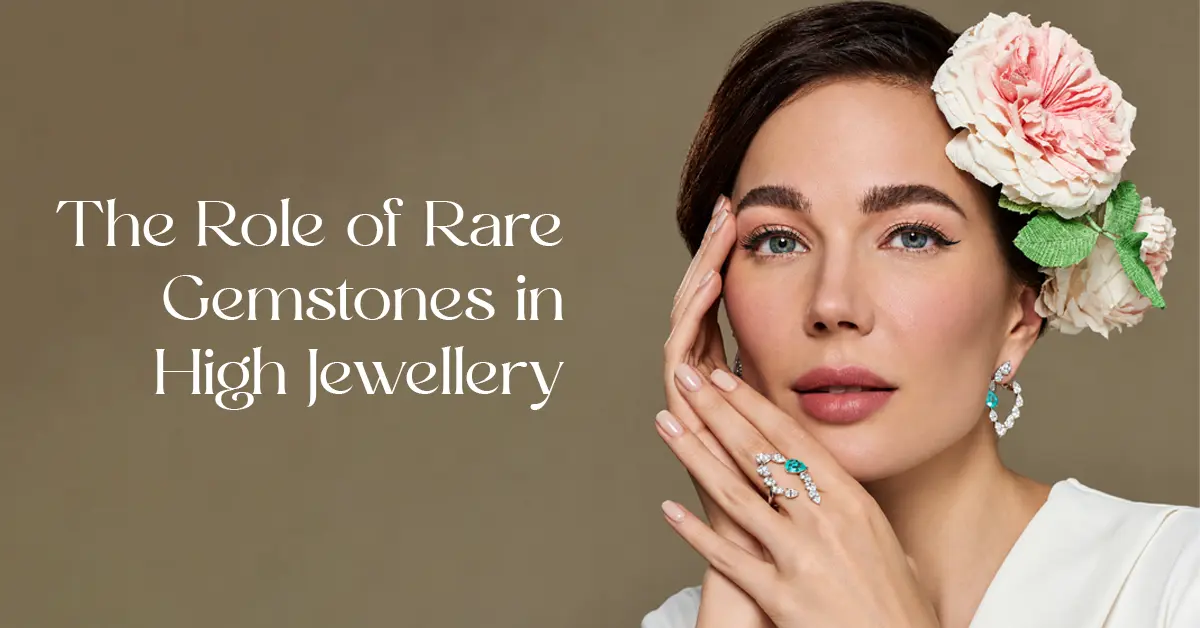
Rare gemstones play a defining role in high jewellery because their exceptional colour, scarcity, character and provenance can determine the entire creative direction of a jewel. In many cases, the gemstone comes first: gemmologists identify an extraordinary stone and designers then create a setting specifically to reveal its colour, proportions and personality.
That is one of the fundamental differences between conventional luxury jewellery and high jewellery. While craftsmanship and design remain essential, exceptional stones often become the heart of the creation.
At Adler Joailliers, this gemstone-led philosophy is particularly important. The Maison states that its in-house gemmologists carefully study and test gemstones before selection and, when an exceptional stone is discovered, designers may develop an entirely new creation around its individual characteristics. Adler Joailliers, Geneva, Switzerland
What makes a gemstone rare?
A gemstone is not considered exceptional simply because it belongs to a famous category such as ruby, emerald or sapphire.
Rarity can be influenced by several factors:
| Factor | Why it matters in high jewellery |
| Colour | Highly saturated or unusually balanced colours can be particularly sought after |
| Size | Fine-quality stones become considerably harder to find at larger sizes |
| Clarity | Exceptional transparency may be uncommon in some gemstone varieties |
| Origin | Certain historic deposits are associated with distinctive material |
| Treatment | Untreated or minimally treated examples may be scarcer |
| Cut | Expert cutting can maximise colour, light and the individual character of a stone |
| Natural characteristics | Unique inclusions, colour zoning or optical effects can create individual beauty |
| Availability | Some deposits produce only very limited quantities of gem-quality material |
Colour is especially important in coloured gemstones. The Gemological Institute of America notes, for example, that intensity and uniformity of colour are major considerations in sapphire quality. Get more information on gia
Rarity, however, should never be judged by a gemstone’s name alone. Quality can vary substantially even among stones from famous locations.
Why are rare gemstones so important in high jewellery?
In high jewellery, an extraordinary gemstone is more than decoration. It can become the starting point for the entire composition.
The shape of an emerald might establish the geometry of a necklace. The unusual glow of an opal may determine the surrounding metal finish. An electric-blue Paraíba tourmaline can establish the colour palette for an entire jewellery set.
This approach reverses the conventional design process.
Instead of saying:
“We have designed a ring. Which stone should go inside it?”
the high jewellery process may begin with:
“We have discovered an extraordinary stone. What should we create around it?”
Adler’s gemmologists describe exactly this process. When an unusual gemstone attracts their attention, the stone itself may inspire a new design, with its shape and colour guiding the artistic interpretation. Adler Joailliers, Geneva, Switzerland
Gemmology comes before jewellery making
Before a rare stone becomes part of a high jewellery collection, it needs to be understood.
Professional gemmological analysis can help establish:
- whether a gemstone is natural;
- its variety;
- whether treatments are detectable;
- colour and clarity characteristics;
- and, for certain gemstones, geographic origin.
GIA laboratories, for example, provide identification and origin services for commercially significant coloured stones including ruby, sapphire, emerald, alexandrite, red spinel and copper-bearing Paraíba-type tourmaline.
At Adler, the Maison says its gemmologists identify gemstones and investigate their origin before considering colour, dimensions and quality within a prospective design. Adler also states that diamonds above 0.50 carat and coloured stones of one carat or more are assessed by independent laboratories.
This level of documentation is particularly relevant when a significant gemstone becomes the focal point of a high-jewellery piece.
Emeralds: colour with individual character
Emerald has occupied an important place in high jewellery for centuries.
Its appeal lies in far more than green colour alone. Fine emeralds can have remarkable intensity and individuality, while natural inclusions, traditionally referred to as the stone’s jardin, can form part of an emerald’s unique internal landscape.
Adler’s Papagayo high jewellery necklace provides a striking contemporary example. The piece is made in 18kt white gold and centres on an 8.06-carat cushion-cut Colombian emerald, accompanied by oval-cut emeralds and diamonds.
The central stone does not simply sit within the design. Its colour establishes the visual language of a necklace inspired by the richness of the natural world.
Another Adler creation, Laurea, uses 21 marquise-cut emeralds totalling 11.43 carats alongside 823 diamonds. The emeralds are arranged to evoke laurel leaves, demonstrating how gemstone shape itself can become an architectural part of a design.
Sapphires and rubies: colour, depth and contrast
Ruby and sapphire belong to the same mineral species — corundum — but their colours give designers completely different creative possibilities.
Sapphire is most closely associated with blue, although it occurs in many colours. GIA notes that more intense and uniform colour is generally associated with higher-value sapphires.
In high jewellery, these gemstones can be used as dramatic central stones or carefully matched across an entire creation.
Adler’s Mistra High Jewellery incorporates royal sapphires, rubies, emeralds and Fancy Yellow diamonds. According to the Maison, gemstones are selected for their brilliance and depth of colour, with open structures designed to allow light to move around the central stones.
This highlights an important point: the gemstone and its setting cannot be considered independently.
The finest setting does not overpower a rare stone. It gives it space to perform.
Why Paraíba tourmaline has become important in contemporary high jewellery
Few modern gemstone discoveries illustrate rarity and colour as clearly as Paraíba tourmaline.
Copper-bearing tourmalines can display striking blue, greenish-blue and violet colours. GIA describes the vivid blues and greens associated with Paraíba material as exceptional within the tourmaline family and notes that rarity is one factor behind the strong demand for high-quality stones.
Large fine examples are particularly uncommon.
Paraíba tourmaline also demonstrates how contemporary high jewellery is expanding beyond the traditional combination of diamond, ruby, sapphire and emerald.
Adler’s Shinsei collection incorporates Paraíba tourmalines alongside emeralds, rubies, diamonds, mother-of-pearl, carbon and gold, creating a much broader palette of colours and textures. This willingness to explore less conventional gemstones is an important part of modern high jewellery design.
Opals demonstrate why no two gemstones are truly identical
Not all rare gemstones derive their appeal from transparency or perfect clarity.
Opal demonstrates the opposite.
Its shifting play of colour can reveal combinations of blue, green, yellow, orange and other shades that change as the stone moves.
Adler’s Nebula collection was created after the discovery of three opals whose colours reminded the Maison of planetary nebulae. Each ring was designed around the unique visual characteristics of its individual opal.
That is high jewellery in perhaps its purest form: nature creates something that cannot be precisely repeated, and the jeweller responds to it.
Why provenance matters
For certain exceptional gemstones, geographic origin can become another part of their identity.
Colombian emeralds, Kashmir sapphires, and Brazilian Paraíba tourmalines are examples of geographic descriptions that may carry significance in the gemstone trade.
However, provenance should be supported by appropriate gemmological evidence rather than assumptions based on appearance.
GIA notes that independent laboratory documentation of Paraíba origin, for example, can affect how fine-quality stones are perceived in the market.
Professional laboratory reports therefore contribute to transparency by helping establish what a stone is, whether treatments have been detected and, where scientifically determinable, where it originated.
The designer’s challenge: enhance the stone without overwhelming it
A rare gemstone may be extraordinary on its own, but turning it into high jewellery requires another level of expertise.
Designers and craftspeople must consider:
- how much light should reach the stone;
- which metal best complements its colour;
- how securely it can be set;
- whether surrounding diamonds should create contrast or harmony;
- how weight will affect comfort;
- how the jewel moves when worn;
- and whether the piece should be transformable.
Adler states that its gemstones are individually adjusted and set by hand, using techniques including prong, bead, pavé and bezel settings according to the demands of the particular creation.
The result is a collaboration between geology, gemmology, design and craftsmanship.
Rare gemstones make each high jewellery creation more individual
Perhaps the greatest contribution of rare gemstones is individuality.
Two natural emeralds will not contain exactly the same inclusions. Two opals will not display precisely the same play of colour. Even gemstones of the same variety, weight and origin may differ visibly in tone, saturation and internal character.
This natural variation gives high jewellery designers something that cannot simply be replicated through production.
It also explains why a sophisticated jewellery set may require significant time to assemble: individual stones must work together in size, colour, shape and visual rhythm while retaining their natural character.
For Adler, rare gemstones sit at the centre of this process. The Maison describes its high jewellery as bringing rare stones and innovative materials together through original design and attentive craftsmanship.
From exceptional gemstone to exceptional jewel
Rare gemstones give high jewellery its colour, individuality and sense of discovery, but rarity alone does not create an extraordinary jewel.
It is the combination of gemmological expertise, imaginative design and meticulous craftsmanship that transforms natural material into something meaningful.
A remarkable stone may take millions of years to form. The role of the high jeweller is to understand its character and create a setting worthy of it.
Discover Adler High Jewellery
Explore Adler Joailliers’ world of high jewellery, where emeralds, sapphires, rubies, diamonds, opals and other exceptional gemstones meet distinctive design and Swiss jewellery craftsmanship.
Frequently Asked Questions
What are rare gemstones in high jewellery?
Rare gemstones are natural stones distinguished by an unusual combination of quality, scarcity, colour, size, provenance or other exceptional characteristics. Examples used in high jewellery can include fine emeralds, rubies, sapphires, diamonds, Paraíba tourmalines and exceptional opals.
Why are rare gemstones used in high jewellery?
They provide colour, individuality and artistic inspiration. In some high jewellery creations, designers develop the entire piece around one exceptional gemstone.
Is an emerald rarer than a diamond?
There is no meaningful universal comparison because rarity depends on the type, size and quality being compared. Exceptional examples of both emeralds and diamonds can be extremely scarce.
What makes Paraíba tourmaline special?
Paraíba-type tourmaline is known for vivid blue-to-green colours associated with copper. Fine material with strong saturation is highly sought after, while larger fine-quality examples can be particularly scarce. gia
Does gemstone origin matter in high jewellery?
It can. Origin may contribute to a gemstone’s history and market perception, particularly for certain rubies, sapphires, emeralds and Paraíba-type tourmalines. Reliable origin conclusions should be supported by recognised gemmological laboratories. gia
What is the difference between fine jewellery and high jewellery?
Fine jewellery generally refers to jewellery made using precious metals and gemstones. High jewellery represents the most exceptional level of jewellery creation, typically involving rare gemstones, complex craftsmanship, original design and limited or unique pieces.
What gemstones does Adler use?
Adler works with diamonds, emeralds, rubies and sapphires as well as less conventional gemstones and materials. Collections also feature stones such as Paraíba tourmaline, rubellite and opal.